

The Hobby Gap
How women lose their hobbies and why it is not their fault

As I thought about the “hobby renaissance”, I thought a lot about my own relationship with hobbies, and started paying attention to how the women around me experienced their hobbies (or not).
As a working mom of two in my early 40s, I found myself struggling to remember when I last engaged in my hobbies. I remembered enjoying reading, doing jigsaws, baking, and other hobbies I had at some point in life. But then I couldn’t remember when I last tried a recipe just because, and not for a kid’s birthday party. My loved ones know I love jigsaws and have always been gifting them to me, but I realized the unopened pile was getting bigger and bigger. And to my shock, I realized that for the first time, my list of books I read in the past year was shorter than I wanted to admit. I couldn’t pinpoint when exactly it all happened, but my hobbies had slowly gotten away from me.
Elena* was a colleague in her late 20s, single and without kids. While chatting during a long layover on a work trip, she mentioned that she used to play video games quite seriously. Because it was a whole world I had no experience with, I was fascinated. But soon I was also a bit horrified as she told me about the demeaning jokes and lewd comments she received when some players realized she was a woman. That, on top of having to often explain or prove herself as a bona fide gamer, had sucked the fun out of it, and she said she played less and less.
Rebecca* is a friend who, in the past few years, went through a lot, with a job change and a messy divorce that left her with shattered self-esteem. We were talking about how she was doing as she tried to rebuild her life and sense of self, and she mentioned she went to a trial hip-hop class. She went on and on about how embarrassing it was. How she was so bad at it. How everyone else seemed to already know each other, the songs, and the dance moves. And how she never went back because she couldn’t do it right.
Far from stories of individual failure, these reflect a broader, structural pattern of gender inequality. I am a gender expert by training and trade. I have a PhD in gender, and for the past 20 years, I have worked on gender inequality for the UN, NGOs, governments, and major research institutions. I see gender inequality everywhere because, well, it is everywhere.
And it is in hobbies.
Many dimensions of gender inequality constrain women’s ability to pursue hobbies as tools for rest, leisure, enjoyment, identity, and community.
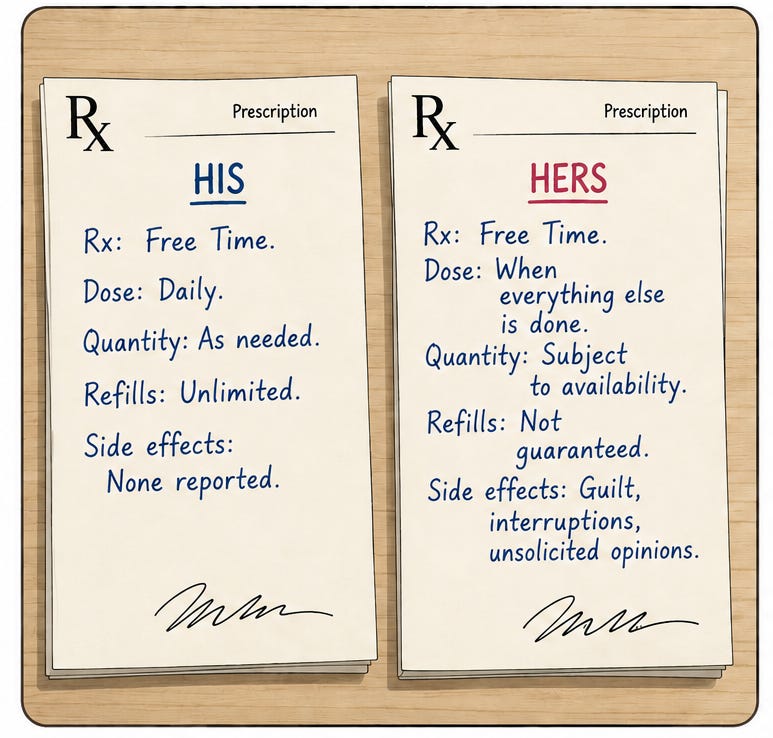
The division of labor is gendered, and time for rest is not distributed equally. Women hold a disproportionate share of unpaid household and care work (including the mental load), and this is well established in the literature and time use surveys. According to the Gender Equity Policy Institute’s Free-Time Gender Gap report, women in the United States spend twice as much time as men on childcare and household work combined and have 13% less free time than men across almost every demographic group, regardless of age, income, and race. For employed, married adults in heterosexual relationships, husbands spend roughly 2 hours more on leisure per week than wives, which amounts to over 100 hours per year, with the gap widening considerably once children enter the picture. Not only do women have less time for leisure than men, but the quality of that time is also lower. A study using data from over 20 countries found that women experience significantly greater pressure during leisure time and are less able to use their free time to genuinely relax and recover.
Social norms that informally regulate gender roles or what is acceptable for men and women also influence women’s experiences with hobbies. Because we shoulder the majority of unpaid household and care work, we are socialized to be caring and to serve others. The idea of self-sacrifice and putting others’ needs ahead of our own is deeply ingrained in most women. And that’s why we feel that rest, leisure, and hobbies must be earned after we complete our never-ending demands towards others. This lack of permission (from society and ourselves) to engage in hobbies is accompanied by shame and guilt: a woman, and especially a mother, who dedicates time to something solely for her enjoyment is perceived as selfish or, at the very least, indulgent.
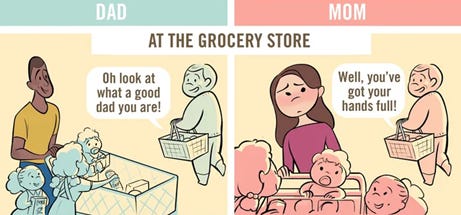
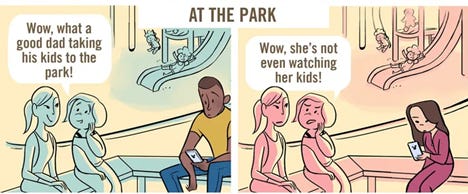
Much of what is considered appropriate women’s behavior is performative, which leads to perfectionism. From childhood, we have to be good. A good girl. A good daughter. A well-behaved student. A good wife. The hostess with the mostess. A good mother. The perfect lover. Attentive friend. Office mom. PTA president. Women’s every move is scrutinized, and we learn early on that nothing short of perfect is good enough. For decades, magazines and marketing have targeted women with advice and products to improve themselves, to learn to do everything better. The bar for a “good dad” is considerably lower than the bar for a “good mom” (see below some of the comics Chaunie Brusie created to illustrate this point). Perfectionism in women is not innate, but the predictable result of decades of impossible standards. Perfectionism is gendered, and it stands between women and hobbies. We avoid, delay, and quit activities we love because we have decided our performance is not good enough.
Gender norms also create a hierarchy of value. In our society, what is associated with women and femininity is constantly devalued. Boys as young as preschoolers refuse to play with a toy if it comes in pink. A study by the Geena Davis Institute on Gender in Media, commissioned by Lego, found that 71% of boys said they worry about being bullied if they play with a toy associated with girls, while only 42% of girls expressed the same concern. The fact that the greatest insult for a man is to be called “girly” says a lot about how we value women. This is reflected in hobbies. Because women’s pursuits are considered inferior, “Swifties” are openly mocked, whereas men who dress up to watch the latest Star Wars movie are just expressing their passion. Some hobbies are coded as female, and others are male, and women face explicit and implicit pushback when they try to enter these male-dominated spaces. To this day, a woman who says she enjoys racing cars or sports can expect to be interrogated about her credentials by men who would never question another man’s. When the price of admission is having to prove you belong, many women never walk through the door, and those who do often do not stay long.
To start and stick with their hobbies, women need to fight against a whole system that is designed against them. Women have less free time and are socialized to feel guilty when they use it for themselves. They navigate a culture that constantly minimizes their work, rest, leisure, and interests while holding them to unattainable standards. This is the architecture of a specific, gendered pattern. I call it the Hobby Gap.
The Hobby Gap is complex. In the posts ahead, I will go deeper into the data, the research, and the real-life stories of women to seriously examine what it actually takes to close this gap.
* I changed names and a few details to protect their privacy.